We Would Cry Three Times: Retirement...As An Adventure by Peg McIntosh
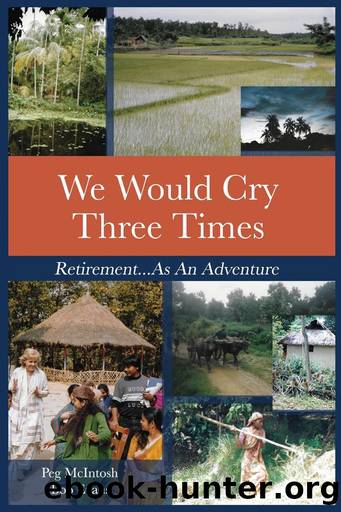
Author:Peg McIntosh
Language: eng
Format: epub
Publisher: Kingman Technology Group LLC
Published: 2018-12-15T00:00:00+00:00
Hajera is 28 years old and the sole support of her family. âMy husband is 80 years old and can no longer work making cane baskets and mats . . .He was married once before but had no children. We have been married for 16 years and have four children, 3 daughters and 1 son.â Her daughters are 14, 10 and 5; and her son is 7 years old. âMy husband stays home and takes care of the children while I work.â
Prior to working at Bonoful, Hajera âhad the knackâ of doing Nakshi Kantha quilting (traditional craft of Bangladeshi needle work). She did this in her home but only made a small income. âWe had to sell our home and use all of the money to eatâ¦now I am working and we have a home and all of my children can go to school. We have a small garden for vegetables and some chickens and ducks.â
Hajera has to get up very early every morning. Before leaving for work, she cooks her familyâs breakfast and lunch. It is three milesâa 45-minute walk or 15-minute rickshaw rideâto the project where she begins work at 8:00 am. Work ends at 5 P.M. but on the way home she has to stop to fetch water. They have no tube well, so Hajera must carry water for their cooking. She does her washing in the pukur or nearby pond.
Hajera has a 5th grade education and enjoys reading with her children in the evening. At the project she enjoys socializing with the other women. She also attends special courses on legal rights and home management. With her earnings, Hajera participates in the projectâs savings program. âI can make 2 ½ albums or 3 journals (MCC handmade products) a day.â Sometimes, when there are many orders, she brings work home to finish. Therefore, her earnings may vary somewhere between 1,000 and 2,000 Tk a month, of which she can usually save 20 to 100 Tk. (One US dollar equals about 45 taka.)
It is very apparent that Hajera enjoys working. She laughs, âI donât like staying at home any moreâthere is little to occupy myself. At work I can earn money for my family â¦I also visit with my friends. Sometimes we joke and tease each other at work.â Asked what she does in her spare time, she says, âI visit my parents and brothers and sisters, but I also visit my friends from the project.â
Hajera says that because of working, she has a very different life. Her position in the family has changed. Because she works to support her family, even her parents show her a new appreciation. Her children try to be cooperative and the eldest child actually helps with the work. They have no clock, so, in the morning when the sun gets up in the sky, the children say to her, âYou can go now, you donât have to stay with us.â If it seems to be getting late, they say, âYou must hurry,
Download
This site does not store any files on its server. We only index and link to content provided by other sites. Please contact the content providers to delete copyright contents if any and email us, we'll remove relevant links or contents immediately.
The Brazilian Economy since the Great Financial Crisis of 20072008 by Philip Arestis Carolina Troncoso Baltar & Daniela Magalhães Prates(150781)
International Integration of the Brazilian Economy by Elias C. Grivoyannis(111108)
The Art of Coaching by Elena Aguilar(53299)
Flexible Working by Dale Gemma;(23300)
How to Stop Living Paycheck to Paycheck by Avery Breyer(19743)
The Acquirer's Multiple: How the Billionaire Contrarians of Deep Value Beat the Market by Tobias Carlisle(12342)
Thinking, Fast and Slow by Kahneman Daniel(12335)
The Radium Girls by Kate Moore(12048)
The Art of Thinking Clearly by Rolf Dobelli(10520)
Hit Refresh by Satya Nadella(9148)
The Compound Effect by Darren Hardy(8993)
Tools of Titans by Timothy Ferriss(8424)
Atomic Habits: Tiny Changes, Remarkable Results by James Clear(8361)
Turbulence by E. J. Noyes(8063)
A Court of Wings and Ruin by Sarah J. Maas(7870)
Change Your Questions, Change Your Life by Marilee Adams(7798)
Nudge - Improving Decisions about Health, Wealth, and Happiness by Thaler Sunstein(7719)
How to Be a Bawse: A Guide to Conquering Life by Lilly Singh(7503)
Win Bigly by Scott Adams(7210)
